

Tax Advisors in Cyprus: Finding an Accountant, Costs & How to Work Together — the Expat's Practical Guide (2026)
Most people who move to Cyprus have done their homework on non-dom status, the 60-day rule and tax rates — and are then surprised to find that the real challenge lies somewhere else entirely: in the day-to-day reality of bookkeeping. Because on paper, the Cypriot tax system is attractive, but it works completely differently from the systems most expats arrive from. Different professional roles, different deadlines, different language, different working culture.
The good news: most of the tax problems expats run into here aren't actually tax problems. They're organisation and communication problems with the accountant. And those can be solved — if you know how the working relationship runs here.
In this guide: how to find a good accountant, what one costs, where the collaboration typically breaks down (spoiler: receipts and reverse charge) and how to build your setup from day one so that the end of the quarter isn't a stress event — including the tool we use for our own receipts.
Cyprus Expats tip: The most honest accounts of working with a particular accountant rarely come out of a Google search — they come from people who have just been through it themselves. That conversation runs continuously in our community. Drop in on community & events →
Why you (almost always) need an accountant in Cyprus
Cyprus runs on a self-assessment system: you are responsible for calculating, reporting and paying your taxes correctly and on time. There is no assessment notice to wait for — there are deadlines you either meet or miss.
In concrete terms, for the self-employed and company owners that means:
- Quarterly VAT returns, with filing and payment due by the 10th of the second month after the quarter ends
- Monthly VIES declarations as soon as you supply services to business customers in other EU countries
- Provisional tax: an estimate of the current year's profit, payable in two instalments (31 July and 31 December) — estimate far too low and you pay a surcharge
- Your personal tax return (IR1) via the government portal
- For Ltds: annual financial statements with an audit by a licensed auditor — very small companies qualify for a lighter-touch review, but there is no way around it entirely
On top of that come the government portals (Tax For All, TAXISnet), which run in Greek and English. As an employee with no side income you can often manage on your own. As a self-employed person or Ltd owner, you're flying blind without an accountant — especially since Cyprus's tax reform took effect on 1 January 2026 (corporate tax up from 12.5% to 15%, the income tax-free allowance raised to €22,000, new SDC rates) — you need someone who can tell you what of it actually affects you.
There is no "tax advisor" profession in Cyprus — what works differently here
The first culture shock: the standalone, regulated tax advisor profession that many European countries have — Germany's Steuerberater, for example — doesn't exist in Cyprus. The role is filled by the accountant or auditor, licensed through ICPAC (the Institute of Certified Public Accountants of Cyprus). Many firms are audit firms at the same time and will also audit your Ltd.
A few things follow from this that you should know:
- No fee schedule. Unlike Germany's statutory fee schedule for tax advisors, there are no fixed rates. Prices are a matter of negotiation — always get a written fixed-price offer (engagement letter).
- No DATEV, no standard process. Every firm works differently: one wants Excel sheets, the next a folder of paper, the third email attachments. A standardised digital handover of the kind German accountants run through DATEV is the exception here, not the rule.
- English is the working language. The tax vocabulary you know from home rarely maps 1:1. You'll be working with input VAT, capital allowances and recapitulative statements.
- A different communication culture. Cypriot accountants are generally competent and friendly — but rarely proactive. Reminders, follow-ups, deadline tracking: that's on you. Think of yourself as the project manager of your own taxes.
Finding a good accountant: criteria, costs, red flags
How to spot a good one
- ICPAC licence — verifiable in the public register
- Demonstrable expat and non-dom experience: they should be able to explain non-dom status and the registration steps after the Yellow Slip without looking anything up
- They explain reverse charge without dodging the question — the best quick test for freelancer experience
- A written fixed-price offer with a clear scope of services: what's included (VAT returns? VIES? IR1? Payroll?), what costs extra?
- A digital way of working: they accept structured digital receipts instead of paper folders
What it costs
Rough ballpark figures, varying by region and volume: as a freelancer you'll usually land at €600–1,500 per year for bookkeeping, VAT returns and your tax return. With an Ltd including the mandatory audit, expect €1,500–3,500 and up. Significantly cheaper offers usually come with a catch: either services are missing (VIES? Provisional tax?), or you're one of 400 clients and never hear from them again.
Not sure whether an offer sits in the normal range? Posting the key figures anonymously in the Cyprus Expats community is often the fastest reality check — other members usually have a current quote at hand to compare it against.
Red flags
- No engagement letter, everything verbal only
- Promises like "with us you won't pay any tax at all" — the opposite of reputable
- Receipts on paper only, or "just bring everything in at the end of the year"
- Only gets in touch shortly before deadlines and then wants everything immediately
- Can't or won't name references from other expats
The simplest counter-check for that last point: ask in the Cyprus Expats community before you sign. A concrete question like "Does anyone know a good accountant for an Ltd in Paphos?" usually gets honest answers the same day — including the names to steer clear of.
The six typical challenges — and how to defuse them
This is where the real problems arise in practice. Not in the tax calculation itself — but on the way there.
1. Receipt chaos
The classic: receipts live as WhatsApp photos on your phone, as PDFs in your inbox, as paper in your car. At the end of the quarter your accountant sends a reminder, you spend two evenings searching, a third of it is missing, and every follow-up question ("What was this payment from the 14th?") costs a day of back-and-forth. Missing receipts ultimately mean: no input VAT deduction, estimated figures, unnecessary tax.
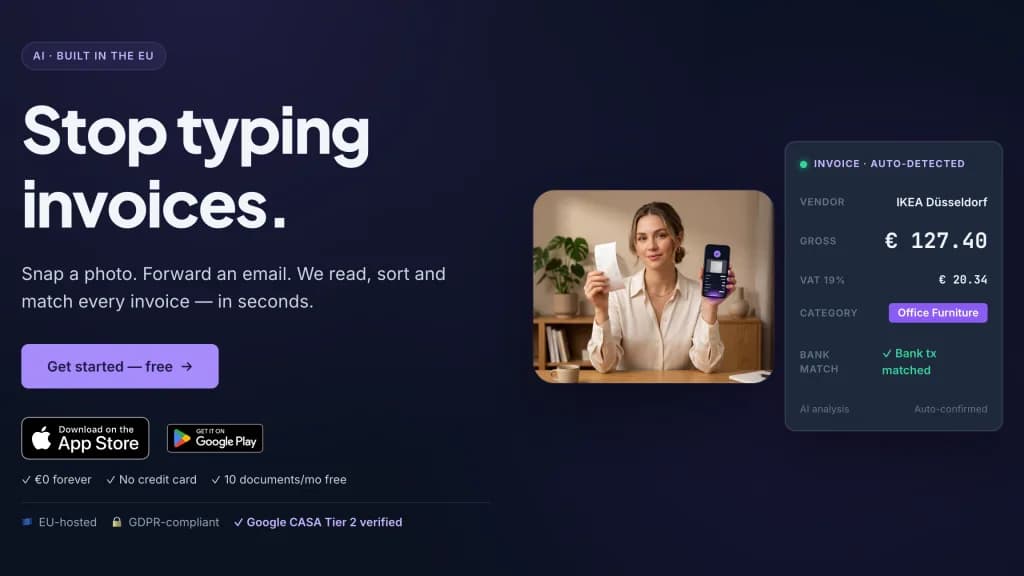
There is now a simple fix for exactly this chaos: tools like TaxItEasy® read receipts automatically as you photograph or forward them and match them straight against your bank account, instead of you hunting them down at quarter-end. How that works in detail is further down.
2. Reverse charge — stumbling block number one
If you sell services as a Cypriot business to business customers in other EU countries, or buy them from there, the reverse-charge mechanism kicks in: the VAT liability shifts to the recipient of the service (Art. 196 of the EU VAT Directive).
In practice that means:
- Your invoice to an EU business customer — say, a German GmbH client — goes out without VAT, with both parties' VAT numbers and the note "Reverse charge". For that you need a VIES registration and have to report these sales monthly.
- Incoming invoices from Google, Meta, AWS or your SaaS stack (usually from Ireland or Luxembourg) arrive without VAT — you have to self-account for Cypriot VAT on them in your own return. With full input VAT deduction it's a zero-sum game, but you still have to report it.
The typical mistakes: forgetting the VIES registration (penalties), never declaring reverse-charge purchases (surfaces at the audit at the latest), or paying your old home country's VAT out of habit on invoices that should long since have been accounted for in Cyprus. Your accountant can handle all of this cleanly — but only if they actually see every single one of those invoices. Which is exactly why the receipt issue from point 1 is not a cosmetic problem.
3. The deadline culture
VAT by the 10th of the second month after the quarter, VIES monthly, provisional tax on 31 July and 31 December, plus the IR1 and the annual financial statements: Cyprus has a dense deadline calendar, and missed dates cost surcharges and interest. Many accountants only get in touch a few days before a deadline asking for documents — if your receipts aren't at hand by then, things get hectic or expensive.
4. Language barrier and terminology
Even with solid English: tax English is a language of its own. If your accountant asks for the "recapitulative statement" and you think of a summary rather than the VIES declaration, you get exactly the kind of small misunderstanding that becomes expensive later. Ask twice rather than once and get terms in writing — a good accountant explains patiently.
5. Being proactive is on you
Back home, your tax advisor probably reminded you. In Cyprus it usually works the other way round: whoever pushes, wins. The single most effective measure is a monthly rhythm — hand over receipts and bank statements once a month instead of once a quarter. That spreads the workload, surfaces errors early and turns you from supplicant into the firm's most pleasant client.
6. Your Cypriot accountant won't know your home country's special topics
If you're moving from Germany: exit taxation on GmbH shares, the double-taxation treaty, Germany's extended limited tax liability, the final German tax return for the year you leave — that's German tax law, and your Cypriot accountant will, rightly, have nothing to say about it. For the transition year you'll generally need a tax advisor in your home country on top. Don't expect the two to talk to each other on their own: you are the interface, and both need the same clean set of documents.
Your receipt system from day one — keeping the handover clean
Five of the six problems above share the same root: receipts and data reach the accountant incomplete, unstructured and late. The solution is a simple principle: one channel, digital immediately, handed over monthly.
That's exactly what we use TaxItEasy® for — an app developed in Cyprus, built together with a practising tax advisor. The principle:
- A receipt exists → the receipt is captured. Photograph receipts with the app or simply forward invoice emails to your personal inbox address. The AI extracts over 25 data points per receipt — supplier, amounts, VAT, individual line items — and detects duplicates.
- Bank reconciliation instead of a guessing game. Transactions are matched to receipts via four signals (reference, amount, date, counterparty), and the system learns from every correction. The question "What was this payment from the 14th?" mostly answers itself.
- Your accountant works with it directly. Through the advisor portal they see your documents structured in their own work queue, request missing receipts with one click instead of an email thread, and every step is documented in an audit trail. Many Cypriot accountants gladly embrace a setup like this — it saves them the same sorting work it saves you.
Important: TaxItEasy doesn't replace your accountant — it makes sure they receive complete, structured documents instead of a shoebox. The data is hosted in Frankfurt, GDPR-compliant and encrypted. Getting started is free: 10 receipts per month, free forever, no credit card — more than enough to test it with your real volume of receipts.
→ Start for free and head into your next quarter-end relaxed
Checklist: what your accountant needs from you every quarter
Save this list — it's the difference between two days of chaos and half an hour:
- All purchase invoices and receipts — including the small ones (fuel, software subscriptions, office supplies)
- All sales invoices for the quarter, sequentially numbered
- Bank statements for every business account (including Wise, Revolut & co.)
- Your EU business customers' VAT numbers for the VIES declaration — ideally already on the invoice
- Reverse-charge purchase invoices (Google, Meta, SaaS) — don't sort them out, they belong in the VAT return
- Private portions marked: what was private, what was business, where were there private contributions?
- New contracts and larger purchases from the quarter
- Your questions collected in one email instead of twelve separate ones
If you keep this up monthly (or have it kept up for you — see above), the quarterly deadline is just another date in the calendar.
Conclusion: your accountant is your most important local partner
The tax side of your move stands or falls not with the perfect tax rate, but with an accountant you trust — and with a system that delivers complete documents to them. Find someone with an ICPAC licence and expat experience, insist on a written offer, establish a monthly handover rhythm and digitise your receipts from day one. Then Cyprus's tax system is exactly what you hoped for when you moved here: predictable.
Get your receipts under control before the next quarter ends: TaxItEasy® automatically reads your receipts via photo or email forwarding, matches them against your bank account and gives your accountant structured access. Free forever for 10 receipts a month, no credit card →
Transparency note: TaxItEasy® is built by THE GROVVEST AI LTD — the company of one of the two founders of Cyprus Expats. In other words: we are recommending our own tool here, and we say so openly.
This article is not tax or legal advice, but editorial guidance. Tax rates, deadlines and thresholds change — the 2026 Cyprus tax reform is the best proof. Always discuss your specific situation with a licensed accountant or tax advisor.
You don't have to face the paperwork alone: Whether it's an accountant recommendation, a quick sanity check on an offer or simply a beer after the quarterly close — that's what the Cyprus Expats community is for. See the next events →
Frequently asked questions
Do I need a tax advisor as an expat in Cyprus?
As an employee with no side income you can often manage without one. As soon as you're self-employed or run an Ltd, a licensed accountant is practically mandatory: quarterly VAT, VIES declarations, provisional tax and the annual financial statements all run through them.
How much does an accountant in Cyprus cost?
As a rough ballpark: freelancers pay around €600–1,500 per year depending on scope, an Ltd including the mandatory audit usually €1,500–3,500 or more. There is no statutory fee schedule like Germany's — prices are negotiable, so always get a written fixed-price offer.
Are there German-speaking tax advisors in Cyprus?
Only a few. The working language is almost always English, with Greek used internally. More important than German language skills is experience with expats and non-dom cases — German special topics such as exit taxation are better covered additionally by a tax advisor in Germany.
What is reverse charge — and does it affect me?
For B2B services across EU borders, the VAT liability shifts to the recipient. You issue invoices to EU business customers without VAT (with a reverse-charge note) and, conversely, have to self-account for VAT on incoming invoices from Google, Meta or SaaS providers in your own VAT return. It affects practically every freelancer with EU clients.
Which tax deadlines do I need to know in Cyprus?
The most important ones: VAT return and payment by the 10th of the second month after the quarter ends, VIES declaration monthly, provisional tax in two instalments (31 July and 31 December), plus the personal tax return (IR1). Your accountant knows the details — but delivering the receipts is on you.
Does my Cypriot Ltd have to be audited?
In principle, yes — Cypriot companies need annual financial statements signed off by a licensed auditor. Very small companies below certain thresholds qualify for a lighter-touch review. That makes an accountant indispensable for Ltd owners.
What's the best way to hand my receipts over to my accountant?
One channel, digital immediately, monthly instead of quarterly. Photograph receipts or forward them by email the moment they arise instead of collecting them. Tools like TaxItEasy extract the data automatically and give your accountant structured access, instead of sorting through WhatsApp photos and email attachments.
Sources
- ICPAC – Institute of Certified Public Accountants of Cyprus — ICPAC
- Cyprus Tax Department — Ministry of Finance, Republic of Cyprus
- Tax For All (TFA) Portal — Cyprus Tax Department
- EU-Mehrwertsteuerrichtlinie 2006/112/EG (Art. 196 – Reverse Charge) — EUR-Lex
- GESY – General Healthcare System — Health Insurance Organisation Cyprus